
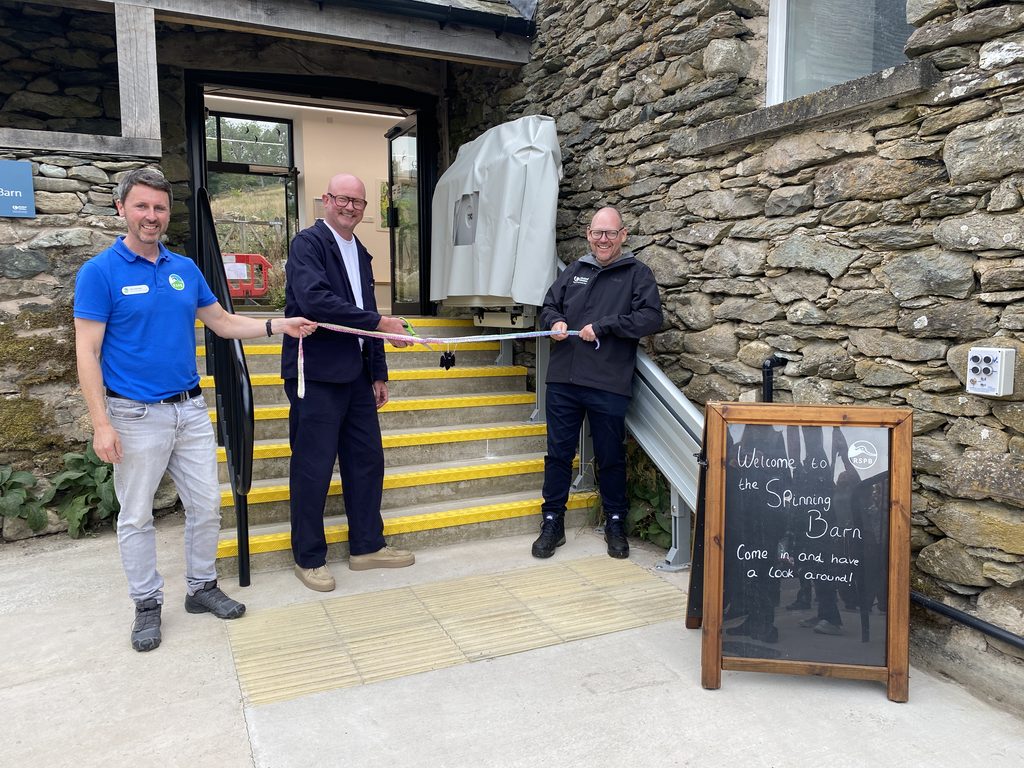

A traditional Cumbrian Spinning Barn has reopened at Wild Haweswater after a £135,000 restoration created a new indoor hub for visiting groups, public events and conservation interpretation.
The RSPB-led project at Naddle Farm was officially opened on 27 August 2026. Funding came through the Landfill Communities Fund from FCC Communities Foundation, supported by private donations, with work designed to benefit visitors, the local community and the barn's resident brown long-eared bats.
What is inside the restored barn?
The new visitor-engagement area uses visual and audio material to explain the landscape recovery led by the RSPB in partnership with landowner United Utilities. A chair lift and accessible toilet improve access, while a kitchen supports group visits, talks and community events.
The refurbishment also reinstated timber features associated with the building's former spinning gallery. Farm workers historically used the balcony to spin wool, giving the building a direct connection with Haweswater's agricultural heritage. Modern interpretation explains how native cattle and Fell Ponies now contribute to conservation grazing.
A restoration designed around bats
The upper “Bat Loft” supports a colony of brown long-eared bats. Working with ecologists, the project added special ridge tiles to provide access, shaped timber around internal steel beams to create roosting spaces and installed additional bat boxes.
Rather than remove the roof in one operation, builders restored it in two halves at different times so the colony retained somewhere to roost throughout the project.
Can the public visit every day?
No daily walk-in opening has been announced. Wild Haweswater describes the Spinning Barn as a hub for pre-arranged professional and community groups, public events and experiences, as well as a break space for volunteers. Naddle Farm remains the project office and has no casual visitor parking.
Anyone interested in seeing or using the building should check the official events programme or arrange a visit directly. This distinction matters because the wider Wild Haweswater landscape does not have a conventional visitor centre, public toilets, café, public hides or signed RSPB trails.
How should ordinary visitors explore Wild Haweswater?
Independent visitors normally use public rights of way and the main car park at Mardale Head, at the southern end of Haweswater Reservoir. The car park is open at all times, but overnight parking is prohibited. The surrounding paths are rugged mountain routes, and phone signal is absent across much of the site.
Bring OS Explorer OL5 or equivalent navigation, food, water, waterproofs, spare layers and a realistic route plan. There is no public bus to the site; Penrith is the closest mainline station, around 14 miles away.
Our new Wild Haweswater visitor guide explains the two different access models: independent walking from Mardale Head and pre-booked events or group visits based around Naddle and Swindale.
Why the opening matters
Wild Haweswater covers around 30 square kilometres of the Mardale, Naddle and Swindale valleys. Its landscape work includes tree planting, peat restoration, re-naturalising rivers, meadow management and conservation grazing. Until now, the team had no comfortable indoor base for the many professional and public groups coming to learn from the project.
The Spinning Barn solves that practical problem while preserving a historic farm building and improving habitat for an existing bat colony. It is therefore more than an ordinary meeting-room conversion: it connects built heritage, inclusive interpretation and active nature recovery in one place.
Opening and visitor-access information checked against Wild Haweswater on 9 September 2026.
Gallery
Tap any photo to open the full gallery.
No approved comments yet.