
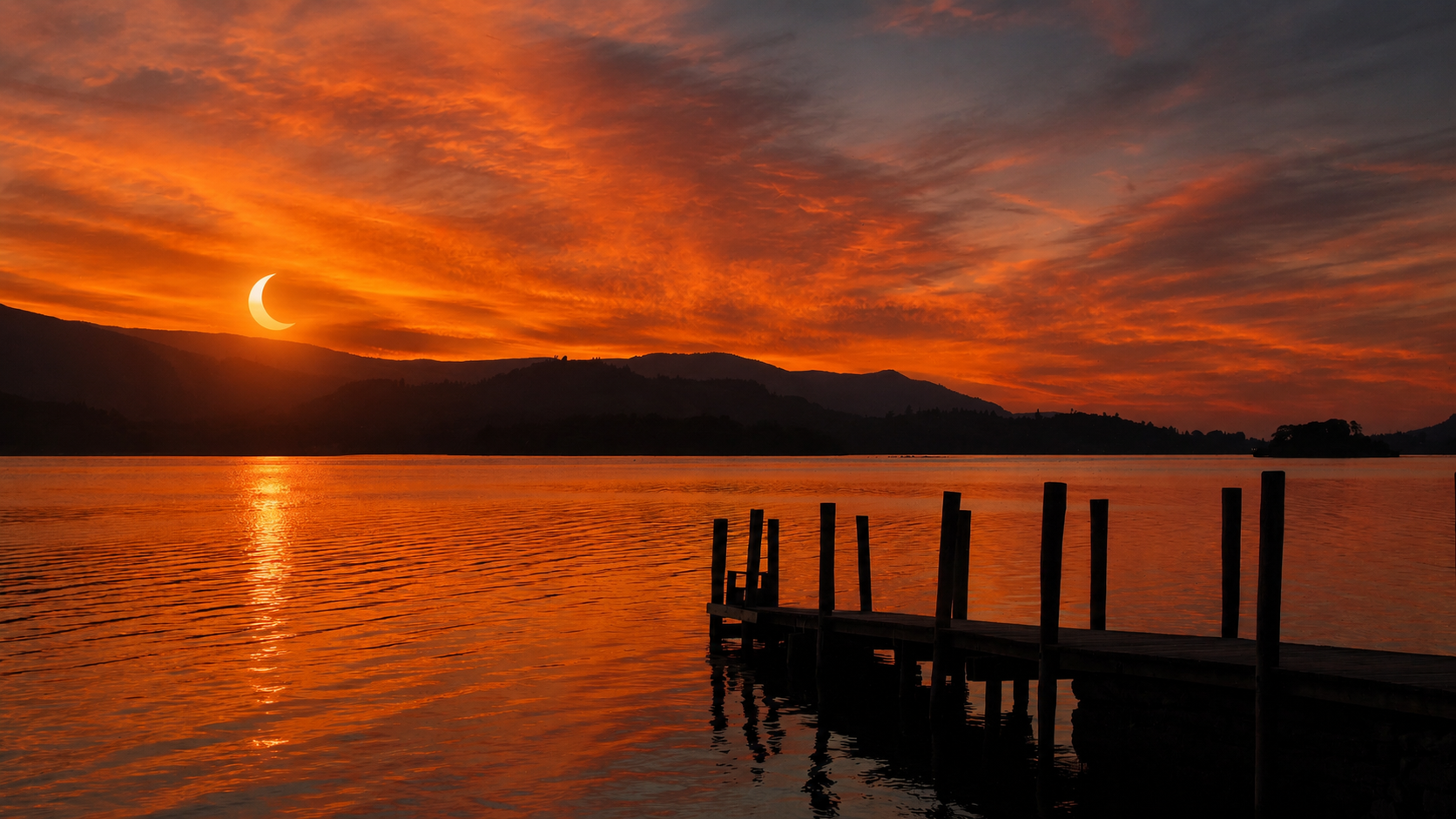

Cumbria is preparing for one of the most impressive solar eclipses visible from the UK in decades, with more than 91% of the Sun's visible area set to be covered by the Moon on the evening of Wednesday 12 August 2026.
The eclipse will be partial everywhere in Cumbria, but it will be a deep partial eclipse. From most of the county it will begin at about 6.11pm, reach maximum at around 7.08pm and finish shortly after 8.02pm.
The Royal Observatory Greenwich describes the event as the best solar eclipse visible from the UK and Ireland so far this century. The UK will not be inside the path of totality, so the Sun will never be completely covered here, but the remaining solar crescent should be striking if skies are clear.
Cumbria also has a geographical advantage for this particular eclipse. At maximum the Sun will be only around 13 degrees above the horizon and almost due west, so places with an open western skyline, especially the west Cumbrian and Solway coasts, could offer some of the clearest views.
Solar eclipse 2026 in Cumbria at a glance
- Date: Wednesday 12 August 2026
- Eclipse type in Cumbria: Partial solar eclipse
- Starts: Around 6.10pm to 6.12pm BST depending on location
- Maximum: Around 7.07pm to 7.09pm BST
- Ends: Around 8.01pm to 8.03pm BST
- Sun covered by area at maximum: Approximately 91.0% to 91.6% across the locations calculated by Cumbria Guru
- Direction at maximum: Around 276.5 to 277.3 degrees, just north of due west
- Height of Sun at maximum: About 13 degrees above the astronomical horizon
- Eye protection: Essential throughout the eclipse
Important: Never look directly at the Sun without suitable solar-viewing protection. Ordinary sunglasses are not safe for viewing an eclipse, even if they are very dark. Cloud does not make direct viewing safe either.
What time is the solar eclipse in Cumbria?
The exact timing varies by a minute or two across the county. The figures below combine published location-specific eclipse data with Cumbria Guru calculations using town-centre coordinates. All times are British Summer Time.
Location Begins Maximum Ends Magnitude Sun area covered Sun height at maximum Carlisle 6:10pm 7:07pm 8:01pm 0.922 91.0% 13.3° Whitehaven 6:11pm 7:08pm 8:02pm 0.927 91.6% 13.6° Workington 6:11pm 7:08pm 8:02pm 0.926 91.5% 13.6° Maryport 6:11pm 7:08pm 8:02pm 0.925 91.5% 13.6° Keswick 6:11pm 7:08pm 8:02pm 0.924 91.3% 13.3° Windermere 6:12pm 7:09pm 8:03pm 0.924 91.3% 13.1° Kendal 6:12pm 7:09pm 8:03pm 0.923 91.2% 13.0°Published calculators may display some contact times one minute differently because of rounding. For planning a visit, arriving well before 6pm is more useful than trying to work to the second.
What does an eclipse magnitude of 0.92 mean?
This is worth explaining because eclipse magnitude and percentage coverage are often mixed up.
Eclipse magnitude measures the fraction of the Sun's diameter covered by the Moon. It is not directly the percentage of the Sun's surface hidden. NASA defines eclipse obscuration separately as the fraction of the Sun's area covered.
For example, Whitehaven's calculated magnitude is about 0.927, while the corresponding area obscuration is approximately 91.6%. Across the Cumbria locations checked for this guide, roughly 91% to 91.6% of the visible solar area will be hidden at maximum.
Where are the best places to see the eclipse in Cumbria?
The most important requirement is not altitude. It is an unobstructed view towards the west.
At maximum eclipse the Sun will sit only about 13 degrees above the horizon at an azimuth of roughly 277 degrees. Due west is 270 degrees, so viewers should look slightly north of west. By the end of the eclipse the Sun will be only around five to six degrees above the astronomical horizon, meaning hills, buildings and trees can hide the later stages surprisingly early.
1. Whitehaven and St Bees
The west coast is arguably Cumbria's strongest option because the eclipse takes place over the Irish Sea side of the county. Whitehaven has a calculated 91.6% solar obscuration at maximum, among the highest figures in this guide.
Public coastal areas with a safe, open view over the sea are preferable to enclosed streets or locations with high ground immediately to the west. Nearby St Bees also has an excellent western outlook. Our calculation for St Bees Head gives a magnitude of about 0.927 and an area obscuration of around 91.6%.
If using cliff-top paths, stay well back from cliff edges and follow local signs. There is no need to stand on an exposed cliff to see the eclipse if a lower public coastal area has the same open horizon.
2. Workington, Maryport and Allonby
Workington and Maryport both have broad western aspects from suitable public coastal areas. Maximum eclipse is calculated at around 7.08pm, with approximately 91.5% of the Sun's area covered.
Further north, Allonby could be an especially attractive option because of its wide Solway Firth horizon. Cumbria Guru's calculation gives maximum at approximately 7.08pm, with about 91.4% obscuration.
These locations may become busy if the forecast remains favourable. Use recognised public parking, do not block access or park on verges, and leave working harbour and industrial areas clear.
3. Ravenglass and the western Lake District coast
Ravenglass gives the western Lake District another open-coast option. Our calculation puts maximum eclipse at approximately 7.09pm with around 91.6% of the Sun's area obscured.
Estuary and coastal locations require a little extra planning. Check tides, remain on recognised paths and do not move onto mudflats or tidal ground simply to improve the view.
4. Carlisle
Carlisle should see the eclipse start at around 6.10pm, reach maximum at 7.07pm and finish around 8.01pm. The published magnitude is 0.922, with our calculation giving about 91.0% area obscuration.
You do not need to travel to the Lake District fells. A safe open space with a clear west to west-north-west horizon can be more useful than a scenic location surrounded by mountains.
5. Keswick
Keswick should reach maximum at about 7.08pm, with around 91.3% of the Sun's area covered.
The challenge is the surrounding topography. The Sun is already low in the western sky, so nearby ridges can shorten the period for which it is visible. Choose an open location with the clearest possible western aspect and avoid assuming that a lakeside view automatically means a clear astronomical horizon.
There is no need to head onto high fells for the eclipse. Evening mountain conditions introduce navigation, exposure and descent-after-sunset risks that are unnecessary for an event visible from low ground.
6. Windermere and Bowness
Published data for Bowness-on-Windermere gives a 6.11pm start, 7.08pm maximum and 8.02pm end, with magnitude 0.924. Cumbria Guru's calculation for Windermere town is within about a minute of those figures and gives approximately 91.3% area obscuration.
The western shore landscape and surrounding ridges mean the actual local skyline matters. A place that looks beautiful at sunset may still lose sight of the Sun before the astronomical eclipse has finished.
7. Kendal
Kendal should see maximum at about 7.08pm to 7.09pm, with published magnitude 0.923 and around 91.2% of the Sun's area obscured.
Kendal's hilly surroundings make site choice more important than on the open west coast. Look for a legal public location with a broad western skyline. If seeing the longest possible portion of the event is the priority, travelling west towards the coast may offer a simpler horizon.
What is the weather forecast for the eclipse?
Latest forecast: Tuesday 11 August
The latest Met Office forecast is now encouraging for eclipse viewing across much of Cumbria. Wednesday is forecast to be dry and sunny across the North West, although high-level cloud may make the sky hazy at times. That haze is now the main weather detail to watch as the eclipse approaches.
The eclipse reaches maximum shortly after 7pm, so the most useful comparison is the Met Office's current Wednesday evening hourly forecast rather than the daytime maximum temperature alone.
| Location | Current 7pm forecast for Wednesday | Chance of rain at 7pm |
|---|---|---|
| Whitehaven | Sunny intervals, around 23°C | Less than 5% |
| Keswick | Sunny, around 27°C | Less than 5% |
| Windermere | Sunny intervals, around 27°C | Less than 5% |
| Kendal | Sunny intervals, around 27°C | Less than 5% |
The Met Office Lake District mountain forecast is similarly positive, describing Wednesday as very warm and mostly dry with good spells of sunshine, with summits expected to remain clear and visibility generally good or excellent. It also warns that sunshine may turn hazy at times and leaves a chance of an isolated shower.
That does not guarantee an unobstructed eclipse. Thin or high cloud can still reduce contrast around the Sun even on a day classified as sunny. Because the eclipse is low in the western sky, local cloud close to the horizon matters more than the headline weather icon.
Cumbria Guru's advice is to check the Whitehaven forecast, Keswick forecast, Windermere forecast and the latest Lake District mountain forecast again on Wednesday afternoon before travelling.
How to watch the solar eclipse safely
The safety advice matters just as much during a 91% eclipse as it does on an ordinary sunny day. A partial eclipse is never safe to view directly without proper protection.
The UK Health Security Agency warns that looking at the Sun without the right protection can permanently damage the retina. The damage may occur without pain, so there may be no immediate warning that an injury has happened.
- Use genuine eclipse glasses or a handheld solar viewer carrying the ISO 12312-2:2015(E) safety standard.
- Inspect eclipse glasses before use. Do not use them if the filter is scratched, torn, creased or damaged.
- Do not use ordinary sunglasses. Dark sunglasses are not an alternative to a solar filter.
- Cloud is not eye protection. Do not look directly at the Sun through cloud.
- Never look through unfiltered binoculars or a telescope. Magnifying optics concentrate sunlight and require a correctly fitted solar filter designed for that instrument.
- Supervise children and make sure they understand that the glasses must remain in place whenever they look towards the Sun.
A simple alternative is indirect projection. A pinhole projector can cast an image of the eclipsed Sun onto a second surface, while a colander or the small gaps between tree leaves can create multiple projected crescents without anyone needing to look at the Sun.
Can I photograph the eclipse?
Do not point an unfiltered camera, phone with optical attachments, binoculars or telescope at the Sun on the assumption that a screen protects your eyes or equipment. Solar photography requires suitable equipment and a solar filter designed for the optical system being used.
For most visitors, the safer and easier option is to photograph the landscape, changing light, people using certified viewers or pinhole projections rather than trying to make a close-up image of the Sun.
Will it go dark in Cumbria?
No. Cumbria is outside the path of totality, so there will always be a bright portion of the Sun visible.
However, with more than 91% of the solar area hidden, the change should be noticeable. The Royal Observatory says a deep partial eclipse can produce a change in light levels and temperature, but it will not create the dramatic darkness of totality.
The unusual quality of the light, combined with the narrow solar crescent and a low western Sun, could still make this a memorable evening across Cumbria.
Where will the eclipse be total?
The 12 August event is a total solar eclipse globally, but the narrow path of totality misses the UK. Totality crosses parts of Greenland, Iceland and northern Spain, with other areas of Europe seeing a partial eclipse.
From the UK and Ireland, coverage generally increases towards the south west. Cumbria's roughly 91% obscuration is slightly lower than the highest UK figures but remains far deeper than an everyday partial eclipse.
What if it is cloudy?
The Royal Observatory Greenwich is planning a free online broadcast of the eclipse from 6.10pm on Wednesday. That provides a useful backup if cloud blocks the Sun locally, although the live stream itself will naturally depend on conditions at its observing site.
If you are travelling within Cumbria, avoid last-minute unsafe parking or rushing onto unfamiliar paths in an attempt to chase a break in the clouds. A missed eclipse is disappointing; a roadside or mountain incident is worse.
Final tips for Wednesday evening
- Check the latest Met Office hourly cloud forecast before leaving.
- Aim to be in position by about 5.45pm so there is no rush before first contact.
- Choose a clear west or west-north-west horizon rather than simply the highest viewpoint.
- Take certified eclipse glasses or use an indirect projection method.
- Use public parking and respect residents, landowners and working harbour areas.
- Stay away from cliff edges, tidal mud and exposed mountain routes unless you would normally visit them safely.
- Expect other people at obvious coastal viewpoints and allow extra travel time.
For a combination of eclipse geometry and straightforward western horizons, Cumbria's west coast remains Cumbria Guru's current pick, particularly the Whitehaven and St Bees coast and the Workington, Maryport and Allonby stretch. As of Tuesday morning, the latest Met Office outlook is supportive of that choice, with Whitehaven currently showing sunny intervals around the 7pm maximum and less than a 5% chance of rain. Check again on Wednesday afternoon in case the high-level cloud forecast changes.
Weather section last updated: 11 August 2026. Eclipse times and safety guidance remain as previously verified.
Explore more local ideas through our Cumbria destination guides and things to do across Cumbria.

No approved comments yet.