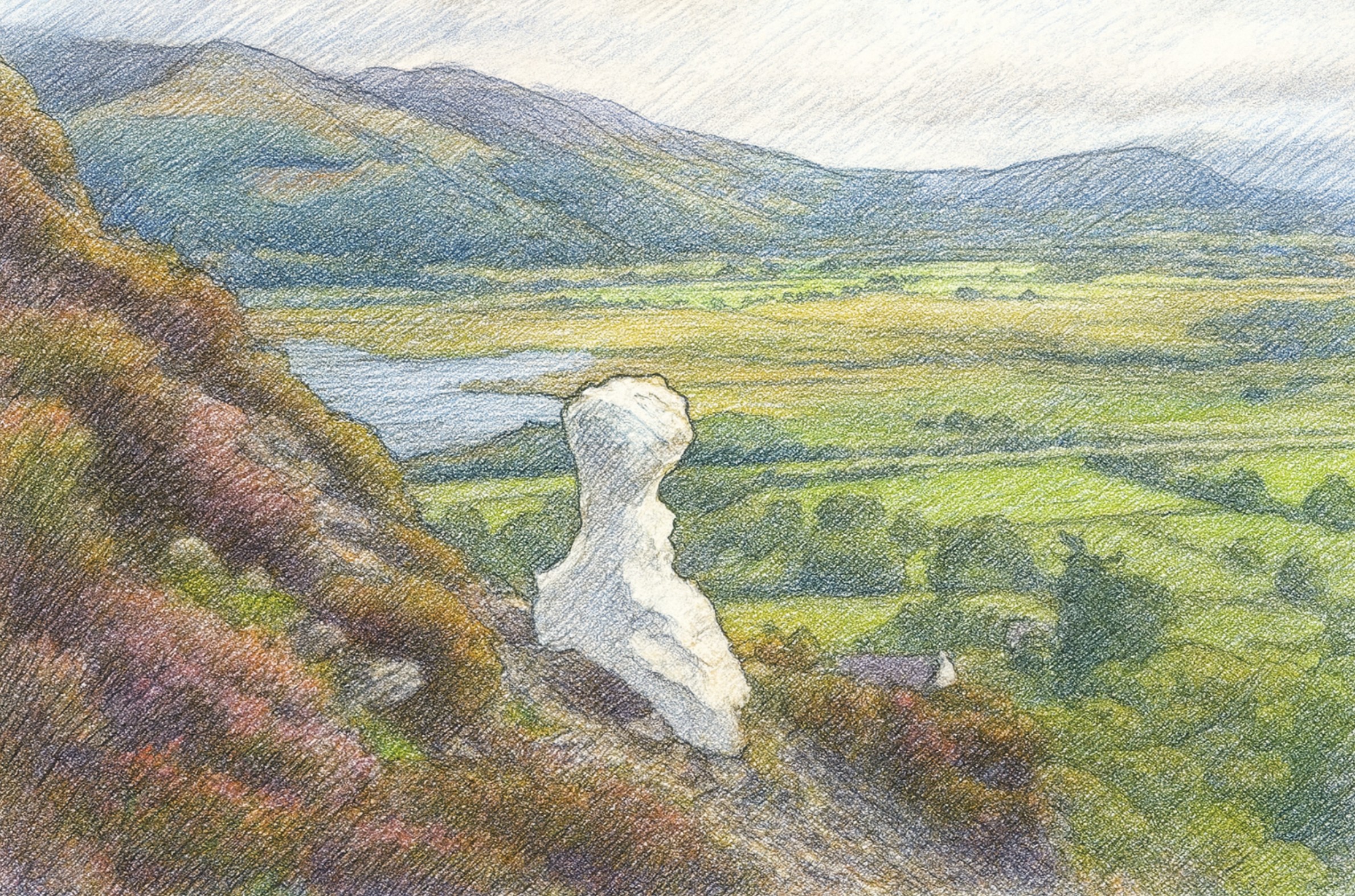
Drive along the A66 near Keswick and you might notice something curious on the fellside above Bassenthwaite Lake: a gleaming white rock, standing stark against the grey scree of Barf. This unusual landmark is known as the Bishop of Barf, and behind its bright paintwork lies one of Cumbria’s quirkiest legends.
A Drunken Wager and a Fatal Fall
One of the Lake District’s most enduring stories dates back to 1783. According to local lore, the flamboyant Frederick Augustus Hervey, Bishop of Derry – sometimes called the “Earl-Bishop” – was staying at the Swan Hotel in Thornthwaite when he made a reckless bet. Over drinks, he claimed he could ride his horse straight up the scree-covered face of Barf and reach the summit of Lord’s Seat.
The attempt, so the legend goes, ended in disaster. About halfway up, both horse and rider fell to their deaths. At the foot of the fell, a boulder became known as the Clerk, said to mark their grave, while a jagged outcrop higher on the slope was whitewashed and named the Bishop of Barf.[1][2]
It makes for a dramatic tale, but the facts don’t quite fit. The real Bishop of Derry lived another 20 years, dying in Albano, Italy, in 1803. Still, the myth has endured, passed down by generations of Cumbrians, blending a flamboyant historical figure with the drama of the Lakeland fells.[3]
Quick Facts: The Bishop of Barf
- Location: South-western shore of Bassenthwaite Lake, near Keswick
- Height of Fell: 468 m (1,535 ft)
- Rock Height: The Bishop stands about 7 ft tall
- Legend: Said to mark the fatal fall of Frederick Augustus Hervey, Bishop of Derry, in 1783
- Truth Check: The real Bishop of Derry died in Italy two decades later
- Tradition: Whitewashed every year for over 200 years; now maintained by Keswick Mountain Rescue
- Hazard Warning: Direct scramble route is dangerous and often the site of rescues – safer to ascend via Lord’s Seat
A Landmark Kept White
The Bishop itself stands about seven feet tall and has been kept gleaming white for more than two centuries. Without fresh paint, the rock would quickly blend back into the grey scree.
Traditionally, it was the job of staff at the Swan Hotel to whitewash the Bishop each year, rewarded with a shilling and a quart of ale. When the hotel eventually closed, local volunteers took on the task, and today Keswick Mountain Rescue ensures the Bishop is regularly repainted.[2][4]
Visiting the Bishop of Barf
The Bishop is easy to spot from the A66 between Keswick and Cockermouth – just look up the fellside above the old Swan Hotel cottages. For those who want a closer look, there are two main options:
- View from below – Park in Thornthwaite or in one of the lay-bys along the A66 and admire the Bishop from afar. Binoculars will bring it into sharp detail without the need to scramble.
- Walk up to it – From Powter How near Thornthwaite, a steep path climbs through Beckstones Gill woods past the smaller white-painted Clerk stone before heading up to the Bishop itself. Be warned: this is a serious scramble, not a casual walk. Signs at the foot of the route discourage ascents, and Keswick Mountain Rescue lists it as a local accident blackspot.[4] In January 2023, three walkers had to be rescued from the Bishop route after following an online app, prompting national news coverage.[5] A safer choice is to climb Barf via the forest paths or approach from Whinlatter and Lord’s Seat, then look down on the Bishop from above.
Geology and Hidden Industry
Barf is part of the Loweswater Formation of Ordovician greywacke sandstone, with outcrops of the Kirkstile Formation of the Skiddaw Group lower down. Small-scale lead and zinc mining took place on the slopes between the 16th and 19th centuries, with ores such as blende and galena extracted near Beckstones Gill and Woodend.[6]
Folklore in the Fells
What makes the Bishop of Barf remarkable is not just the rock itself, but the story that clings to it. It’s a reminder that the Lake District’s hills are not only dramatic landscapes but also places rich in legend, pride, folly, and imagination. The Bishop continues to capture attention from drivers on the A66, walkers on the fell, and storytellers who pass on its tale.
Next time you’re heading past Bassenthwaite, glance up the fellside. You’ll see the Bishop of Barf, still gleaming white after all these years, keeping watch over the valley and keeping alive one of Cumbria’s most unusual legends.
Sources
- Alfred Wainwright, A Pictorial Guide to the Lakeland Fells: Book Six – The North Western Fells (1964)
- Bill Birkett, Complete Lakeland Fells (1994)
- BBC Cumbria – Why is a rock near Keswick painted white? (2005, archived copy)
- Keswick Mountain Rescue – Local Accident Blackspots (2023)
- The Guardian – Hiking app changes route after rescue of walkers in Lake District (6 Jan 2023)
- John Adams, Mines of the Lake District Fells (1995)